

Share
Sleigh Bells Ring… Are You Listening?
February 9th, 2026
By Jazmine Aldrich
Oh, what fun it is to ride in a one-horse open sleigh!
Come on it’s lovely weather for a sleigh ride together with you!
What would holiday carols be without sleighing? From Santa’s magic sleigh pulled by a team of reindeer to tales of joyous sleigh rides in good company, sleighs are an indispensable part of our holiday traditions.
Though rarely used by most Townshippers, nowadays, sleighs were a staple of wintertime transportation into the early 1900s. The idyllic scenes of horse-drawn sleighs painted by Melbourne artist Frederick Simpson Coburn (1871-1960) certainly attest to the prevalence of sleighing in Townships history. Without touching on their industrial importance, let’s explore the importance of sleighing in transportation and recreation.
In 1903, J.S. Mitchell & Co. in Sherbrooke advertised its “Fine Swiss Sleigh Bells” as a New Year’s gift idea, while E.W. Abbott & Son in Lennoxville recommended the whole “two-seated and one-horse sleigh” as a gift. F.L. Bean, whose business was situated across from the Albion Hotel in Sherbrooke, proposed that “a pair of fur robes for your friend’s sleigh would probably suit him first rate for a New Year present.” In the same issue of the Sherbrooke Examiner – predecessor to the Sherbrooke Record – P. Biron of East Sherbrooke proclaims the superior craftsmanship of his own handmade sleighs and carioles.
By 1915, the shifting means of transportation was making itself known in local advertising: J.S. Mitchell & Co. endorsed the Clark Heater – “a neat, compact, durable and finely finished device that yields just [the] degree of heat desired” – achieved, they claim, through the burning of its Clark Coal Brickletts (sold separately). Before the Clark Heater, however, sleigh-riders were already finding a myriad of ways to keep their feet warm; for example, A.H. Foss sold soap stone foot warmers for 25 cents each at his shop on Wellington Street, in Sherbrooke. “There is nothing quite so satisfactory,” proclaim J.S. Mitchell & Co., “as comfortable, warm feet on a cold day whether in an Auto, Sleigh or Carriage.” I can’t argue with that!
Sleigh rides were not all comfort and luxury, however: many sleighing accidents resulted in a range of injuries, from dislocated shoulders, to cracked ribs, or worse. These accidents sometimes reveal further evidence of shifting modes of transportation; for example, Mr. S.L. Spafford’s horse was frightened by the Lennoxville street car in January 1899 and backed into the car, smashing the sleigh but fortunately, sparing Mr. Spafford any bodily harm. In other instances, sleigh runners caught on obstacles such as railway tracks and caused accidents, including at least one that involved the driver being dragged 30-40 feet by the reins and – fortunately – coming out of it without any serious injuries.
Sleighing was still important enough in 1921 to make it into the weather report. A report on Christmas weather forecasts across Canada indicated the relative temperature (mild, cold), the weather (overcast, snow, clear), and the sleighing conditions (good, fair) – where applicable; Vancouver and Victoria’s sleighing conditions are notably absent, on account of the forecasted “green Xmas”.
No matter the weather or the sleighing conditions, we at the ETRC hope that a happy holiday season is enjoyed by all, and offer good wishes for the New Year. If you are interested in learning more about our local history, please contact the ETRC Archives.
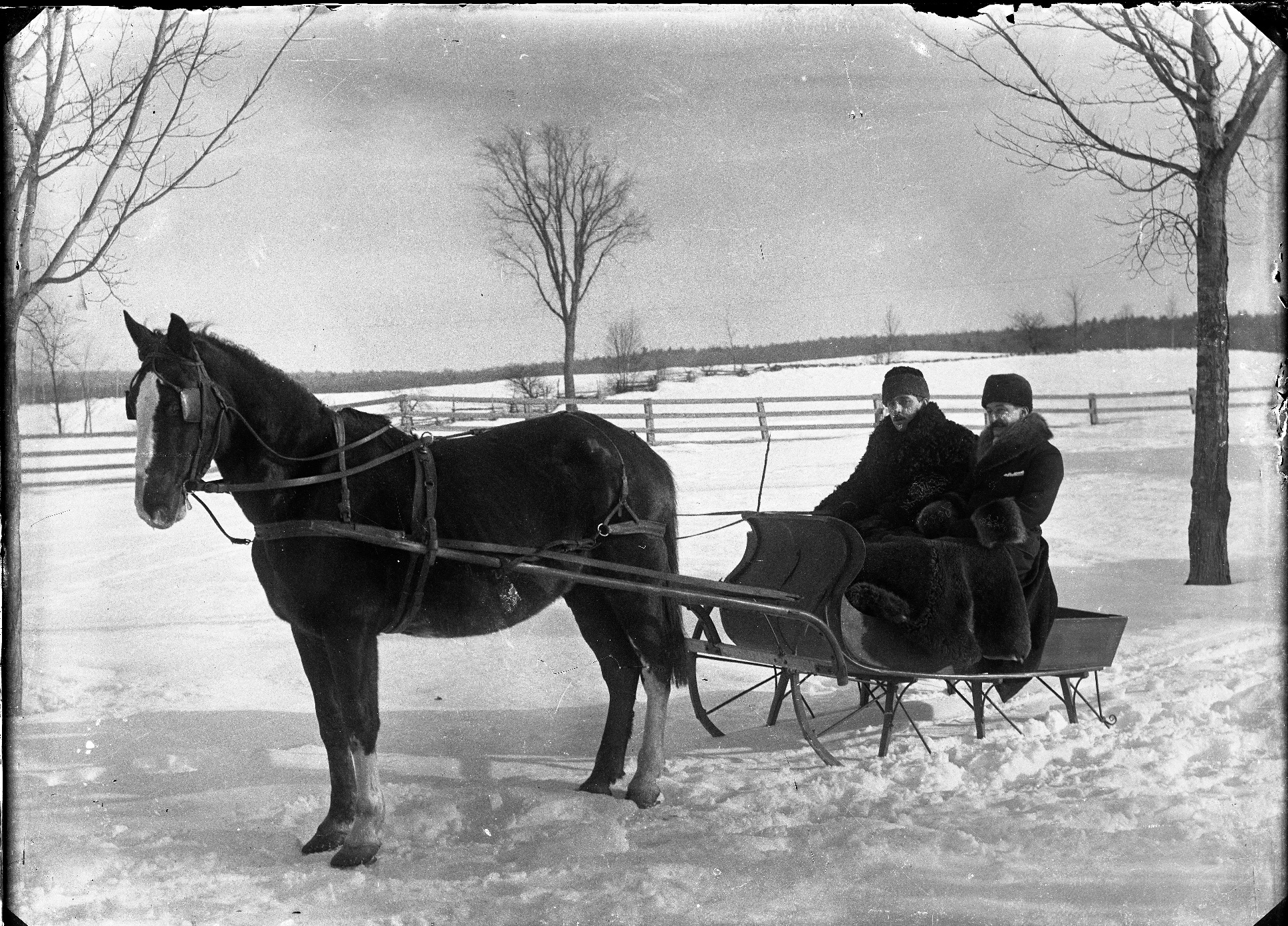
Photo credit : P042 Newton Brookhouse fonds
Two men, sporting fur hats and coats, pose in a horse-drawn sleigh, circa 1900.
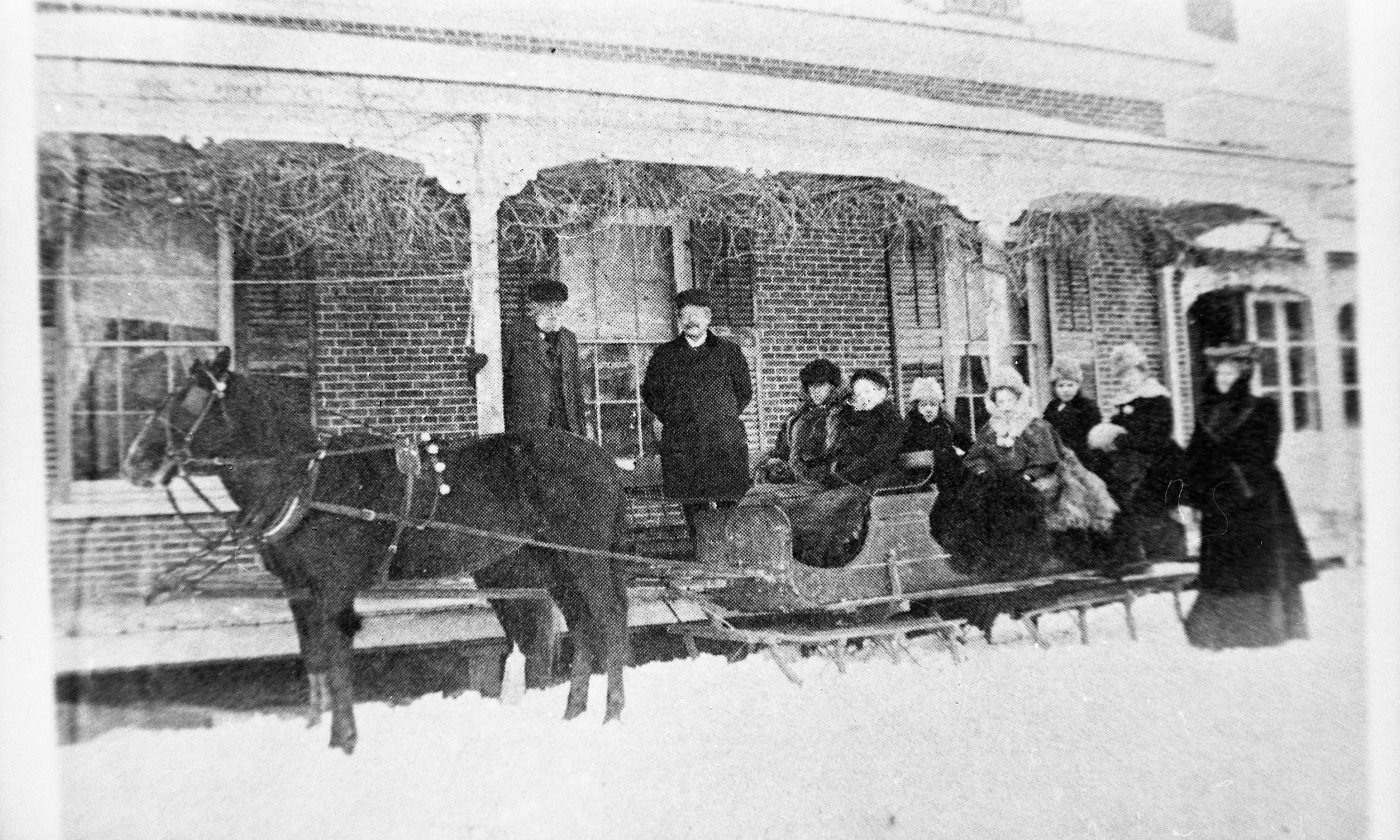
Photo credit : P020 Eastern Townships Heritage Foundation fonds
A group poses in and around an elongated traverse sleigh, in front of the Rice family home in Riceburg (Stanbridge East), around 1912.
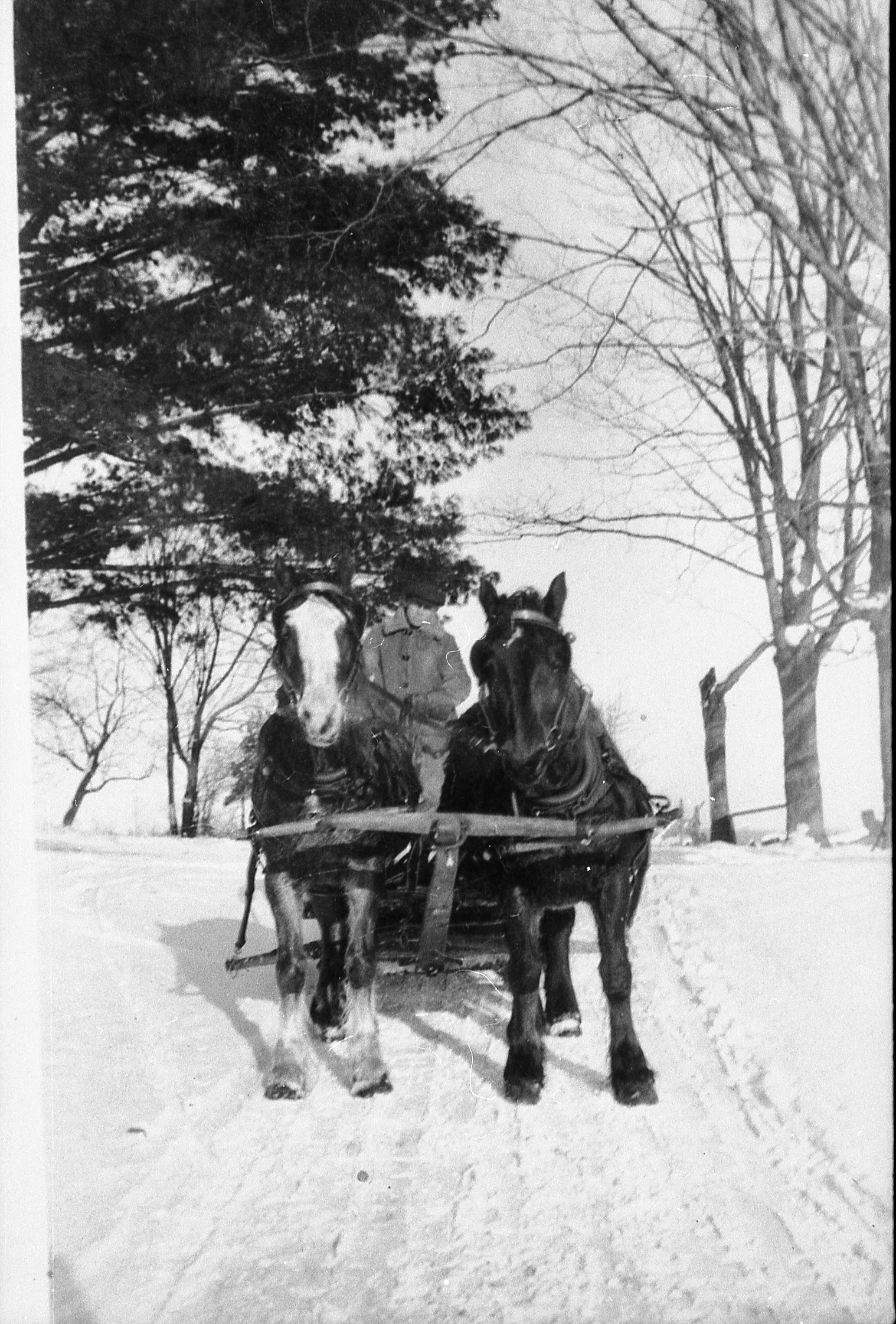
Photo credit : P020 Eastern Townships Heritage Foundation fonds
A pair of horses pull a man in a sleigh, around 1889.