

Share
Broadening our understanding through Townships oral histories
June 15th, 2026
By Jazmine Aldrich
Regular readers of this blog may recall that in January 2025, I wrote about the Eastern Townships Resource Centre (ETRC)’s project to digitize, transcribe, and describe the oral histories within our holdings. This post will serve as an update on that project and a vision of what is still to come.
To recap, the ETRC had over 700 audio and audio-visual recordings digitized from magnetic tape media in 2024. These archival treasures come from 11 different fonds and collections held by the ETRC and range from ethnographic interviews to organizational histories and beyond. Once digital copies were secured, we hired two capable archives technicians – Kevin Mancini and Anna-Karina Poronovich to transcribe and describe the recordings.
This project was initially funded by Library and Archives Canada’s Documentary Heritage Communities Program (DHCP) for the 2024-2025 and 2025-2026 fiscal years. This nearly $100,000.00 investment in local heritage allowed us to embark on a project that we could have only dreamed about as a small heritage not-for-profit.
As of early 2026, the DHCP program has been permanently discontinued; while our funding is secured through the end of our project, never again will community-based organizations such as the ETRC have access to this federal funding. If you would like to stand with Canada’s heritage institutions to protest this and other cuts to critical funding, please write to the Honourable Marc Miller, Minister of Canadian Identity and Culture and Minister responsible for Official Languages.
Though our DHCP funding for transcription and description ran out around the turn of 2026, we were able to secure funding to continue description work through Bibliothèque et archives nationales du Québec (BAnQ)’s Programme de soutien au traitement des archives privées. Kevin and Anna-Karina continued their work through the first quarter of this year, culminating in a presentation at the ETRC’s 14th Annual Colloquium on Quebec Studies, Quebec Past and Present (QPP) on March 27 of this year.
Kevin and Anna-Karina’s presentation at QPP, entitled “From Farm to Archive: An Exploration into Oral Histories of the Eastern Townships” highlighted the richness of the oral histories that they have worked with over the last year-and-a-half. The presenters also offered important takeaways about the role of artificial intelligence (AI) in heritage work. Audience members were fascinated with the project, expressing their interest in a lively question period and in conversation after the panel. Colloquium participants were interested in using the project as a case study for using AI tools for transcription in other heritage projects, and in using the oral histories themselves for a variety of research projects.
The ETRC also benefitted from the support of four practicum students in the McGill University School of Information Studies to advance this project; those students are Leo Jones, Emily Jarjour, Sam Davin, and Jess Flacksenburg. Each student received course credit in exchange for 100 hours of transcription, description, and archival research to write biographical sketches for the interviewees.
There is a second component to the DHCP-funded project that began last August, and that is to record new oral histories to complement our existing holdings. In particular, the focus of the new oral histories is to diversify the voices represented in our holdings by inviting people who identify as 2SLGBTQIA+, BIPOC, immigrants, and other cultural and religious minorities to co-create their own narratives.
As an institution of memory, we know that our collecting practices have historically focused on the dominant members of society; as a result, our archives disproportionately represent Caucasian, heterosexual, cisgendered people who practice Christianity. As people who live in the Townships, however, we know that this does not accurately represent the vibrant society that we live in today, nor has it for much of our Townships’ history. We cannot fabricate historical documents, but we can try to make our archival memory inclusive of more lived experiences moving forward.
Through this component of the project, we are interested in documenting a variety of experiences of living in the Eastern Townships right now and in the last few decades. Following up on the legacy oral histories in our archives that were recorded from the 1970s to the late 1990s, this project serves as an update on life in the Townships from a greater variety of participants and perspectives.
Last summer, the ETRC hired Dr. Ann Scowcroft to conduct the new oral histories. Dr. Scowcroft’s educational, professional, and personal background means that she is well-placed to facilitate these interviews with compassion and curiosity. Dr. Scowcroft has already completed ten interviews with more scheduled in the coming weeks – our goal for the project being twenty new interviews in total.
I will close by saying that the ETRC is actively seeking funding to continue both components of our oral history work. We welcome all suggestions for funding opportunities that might further this work. We also accept monetary donations through the Bishop’s University Foundation. If you are interested in learning more about our work, please contact the ETRC Archives.
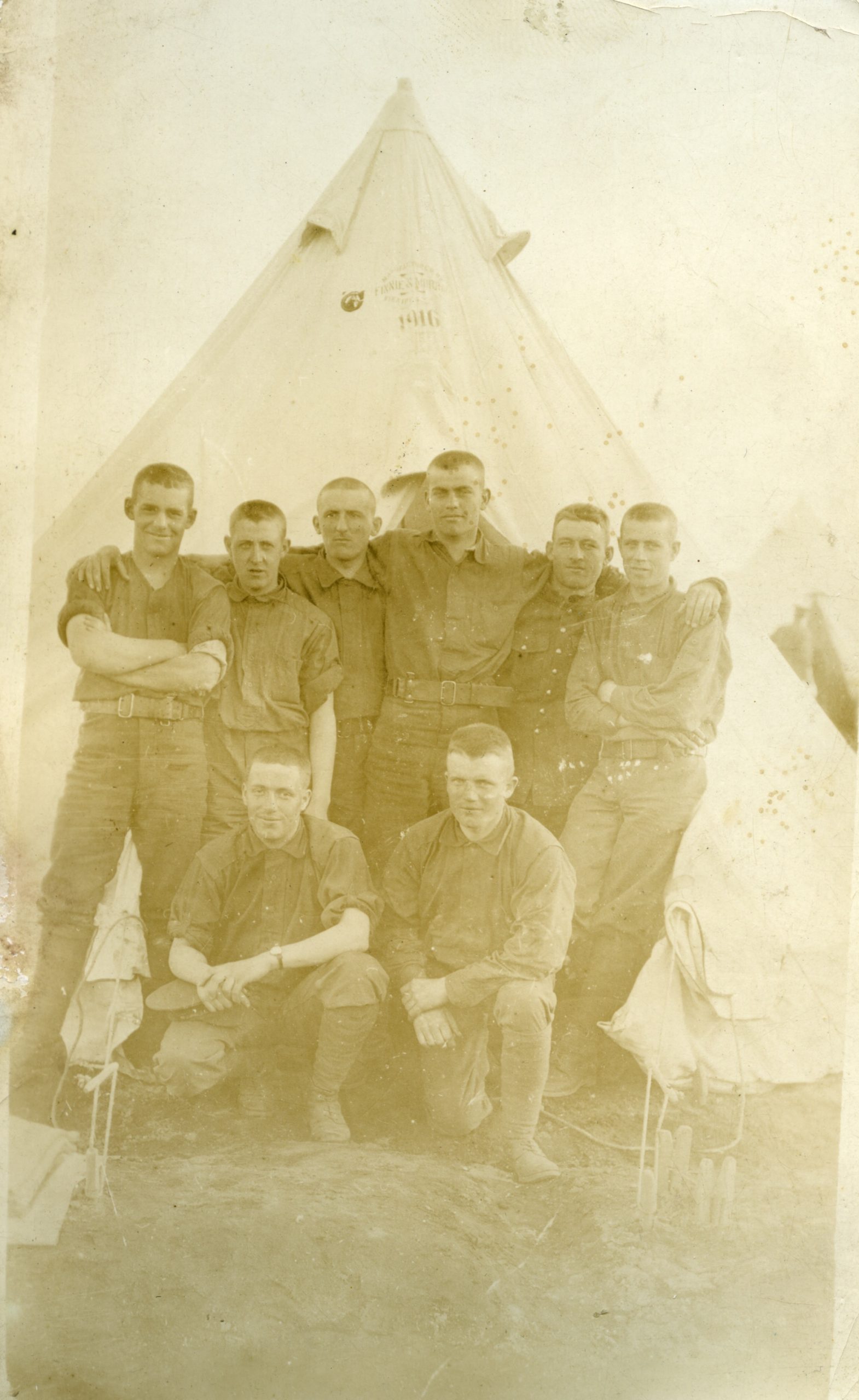
Photo credit : P010 5th Canadian Mounted Rifles Association fonds
Many of the legacy oral histories discuss the World Wars and stories of soldiers not unlike these who served with the 117th Eastern Townships Battalion, pictured here in Valcartier in 1916.
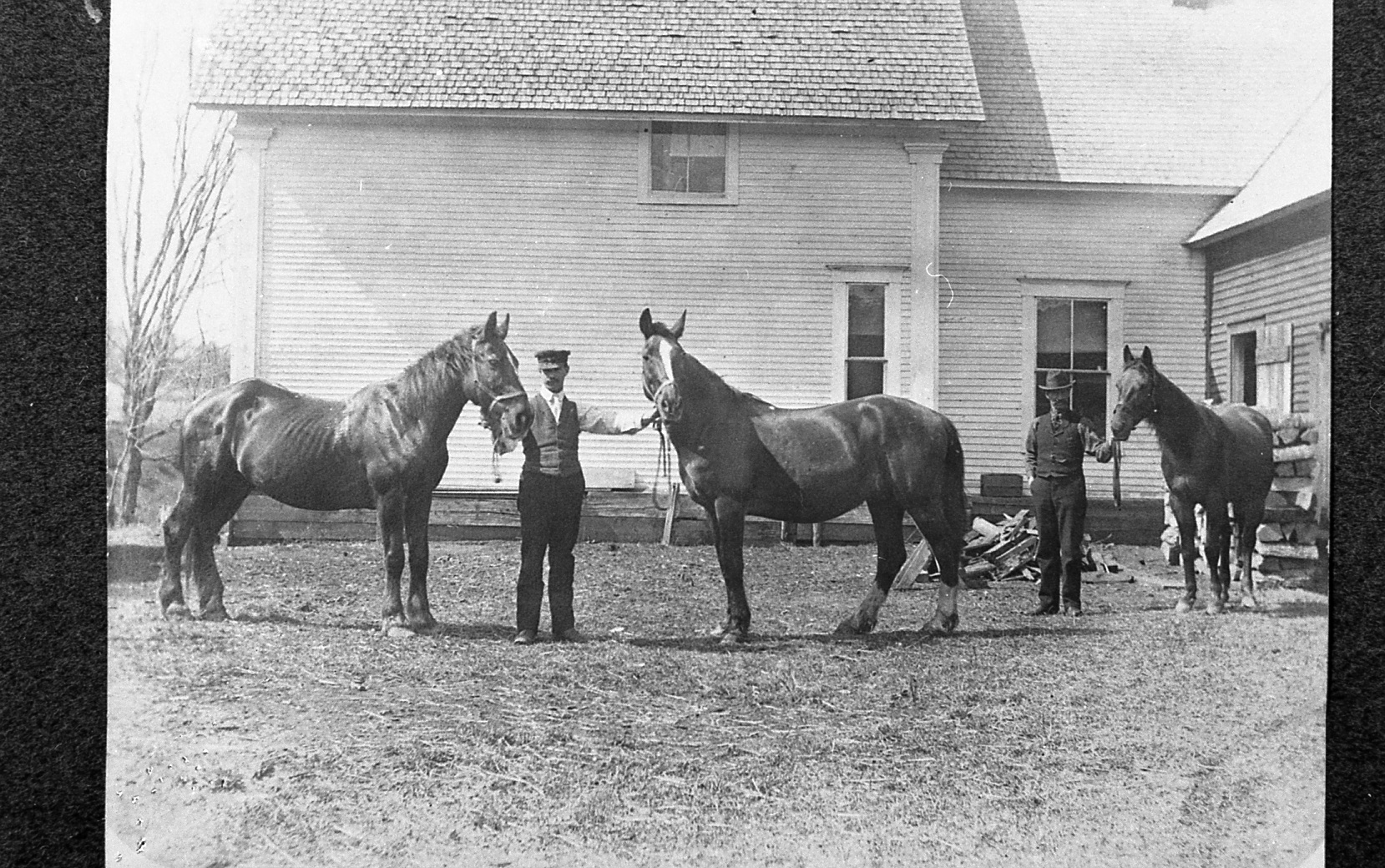
Photo credit : P020 Eastern Townships Heritage Foundation fonds
Livestock rearing is another topic that is well-represented in our oral histories. Pictured here around 1910 are two sons of Calvin Wallace showing horses in front of the family farmhouse in Dixville.
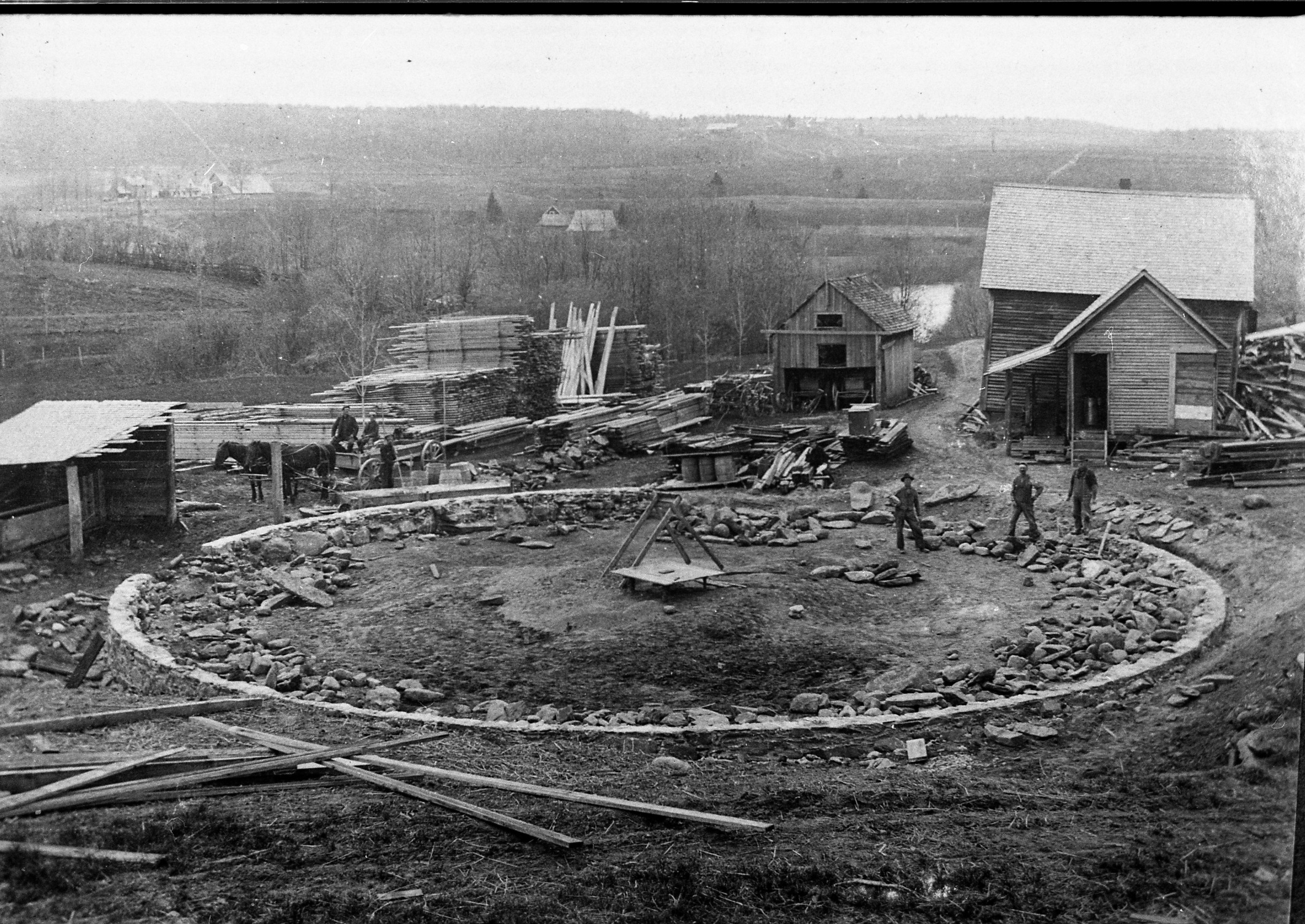
Photo credit : P020 Eastern Townships Heritage Foundation fonds
Many of our legacy oral histories discuss farm life, including barn raisings. Pictured here is a round barn being built on John Cushing’s farm in Dixville, around 1908.